The batch at a glance
Cold-process soap formula
- Yield
- About 6–8 bars, depending on mold and cut size
- Total oils
- 500 g
- Superfat
- 5%
- Cure
- 4–6 weeks
- Fragrance
- Unscented
| Ingredient | Amount | Oil share |
|---|---|---|
| Olive oil | 225 g | 45% |
| Palm oil (regular palm) | 150 g | 30% |
| Coconut oil (76°) | 100 g | 20% |
| Castor oil | 25 g | 5% |
| Sodium hydroxide (NaOH)Calculated at 5% superfat; assumes 100% NaOH purity. | 69.52 g | — |
| Distilled waterAbout 30.2% lye concentration for the listed NaOH weight. | 160.63 g | — |
| Coral-pink cold-process-stable micaOptional colorant; use only within the supplier’s rate for the colored portion. | Start with ⅛ tsp | — |
| Mango-yellow cold-process-stable micaOptional colorant; use only within the supplier’s rate for the colored portion. | Start with ⅛ tsp | — |
- Reserve 5 g of the measured olive oil for each mica dispersion. These 10 g are part of the 225 g total; do not add extra oil.
- No fragrance is included. If you change the oil blend, batch size, superfat, or liquid setting, recalculate the complete formula.
- Plan about 60–90 minutes for preparation and making, then allow 24–48 hours or longer before cutting if the loaf needs more time to firm.
SoapSpice’s current SAP references calculate 69.52 g NaOH for this oil blend at 5% superfat, assuming 100% NaOH purity. Confirm the exact oil types, supplier specifications, and current calculator results before weighing.
Recalculate this batch in SoapSpice01 /
A sunny, unscented in-the-pot swirl
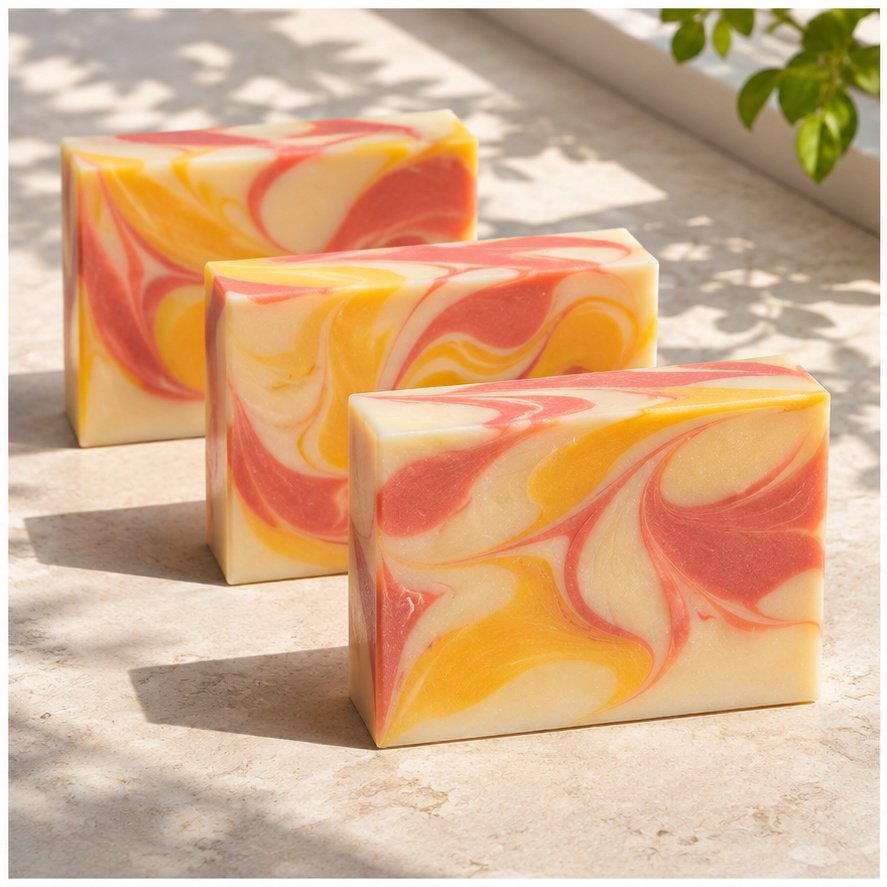
This 500 g cold-process soap recipe combines olive, palm, coconut, and castor oils in an ivory base with coral-pink and mango-yellow ribbons. The colors are mixed into small portions of batter and returned to the main pot for one gentle sweep.
The recipe is unscented. Its illustrations show one possible appearance; the final color and pattern depend on the mica, batter thickness, pouring, and cutting.
02 /
Check the formula before weighing
The listed 69.52 g sodium hydroxide (NaOH) is calculated from SoapSpice’s current SAP references for the exact oils shown, at 5% superfat and assuming 100% NaOH purity. The 160.63 g distilled water amount corresponds to about 30.2% lye concentration.
Re-enter the formula in the SoapSpice calculator and confirm the current result, oil identities, and supplier NaOH purity before making. Recalculate after any substitution or change to batch size, superfat, or liquid setting.
- Choose grams, sodium hydroxide (NaOH), and distilled water.
- Enter 225 g olive oil, 150 g regular palm oil, 100 g 76° coconut oil, and 25 g castor oil.
- Set superfat to 5%, leave fragrance off, then validate and review the displayed quantities.
- Keep the two mica colorants separate from the oil total; reserve their dispersing oil from the measured olive oil.
03 /
Equipment and lye safety
Gather a scale, thermometer, stainless-steel pot, lye-rated polypropylene pitcher, silicone spatulas, two spouted batter cups, immersion blender, and a silicone loaf mold with at least 800 g batter capacity. Set out a soap cutter or straight blade and a ventilated curing rack for later.
Wear splash goggles, chemical-resistant gloves, and long sleeves. Work with ventilation on a clear, stable counter, and keep children and pets away. Use dedicated soapmaking tools; do not use aluminum or fragile glass for the lye setup.
- Read the NaOH supplier’s safety sheet before starting and keep its emergency instructions nearby.
- Slowly add NaOH to distilled water while stirring—always lye into water, never water onto dry lye. The solution gets hot and releases irritating vapor; keep your face away and let it cool in a secure, ventilated place.
- For skin or eye exposure, flush with running water and follow the supplier’s emergency instructions. Do not apply vinegar to skin.
- Weigh all oils, NaOH, water, fragrance-free additives, and colorants as directed; do not replace measured weights with volume estimates.
04 /
Make the mango and coral swirl, step by step
Prepare the mold and color cups before blending so the soap batter is ready to pour while it is fluid. Keep protective gear on through all work with NaOH and raw batter.
- 01
Line or prepare the loaf mold if needed. Label two small cups and disperse each mica in 5 g of olive oil taken from the measured 225 g. Set out two pouring cups and a spatula.
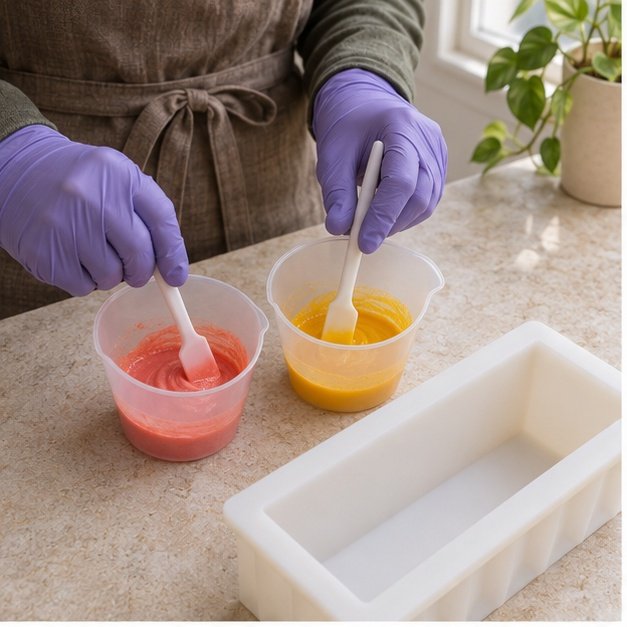
Recipe illustration: prepare both color dispersions before blending. - 02
Weigh the distilled water and NaOH separately while wearing full protective gear. Slowly add the NaOH to the water while stirring. Keep your face away from vapors, then leave the hot solution to cool in a secure, ventilated area.
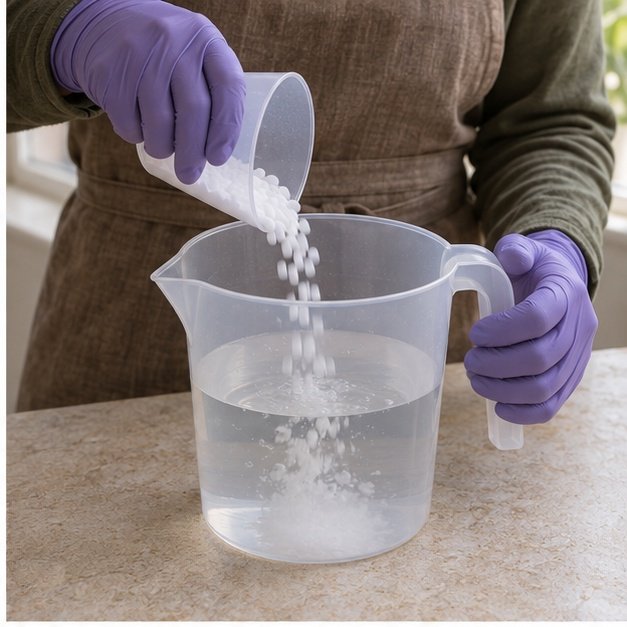
Recipe illustration: add sodium hydroxide to water and let the solution cool safely. - 03
If using bulk palm oil, melt and mix it thoroughly before measuring so its components are evenly distributed. Melt the coconut oil, then combine the palm, coconut, castor, and remaining olive oil. Aim for about 38–43°C (100–110°F) for both oils and lye solution, with all hard fats fully liquid.
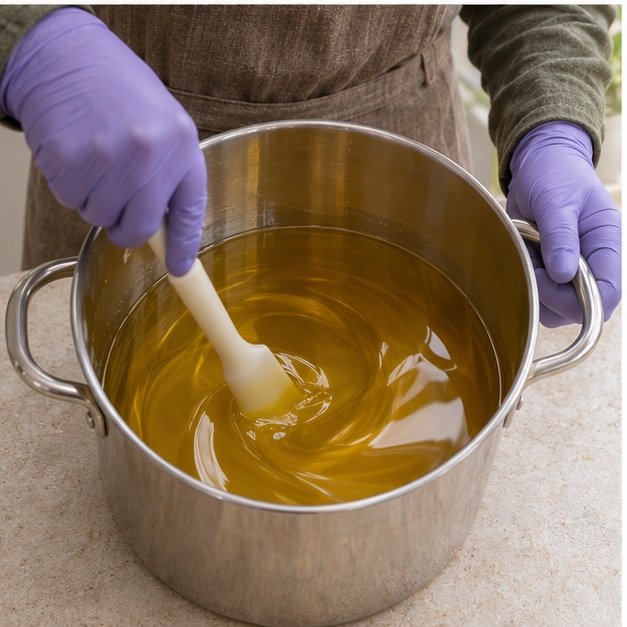
Recipe illustration: melt and combine the measured oils. - 04
Slowly add the cooled lye solution to the oils. Keep the immersion-blender head submerged. Alternate short pulses with hand stirring until the batter is uniform and leaves a faint trail. Stop at fluid light trace; thick batter is harder to swirl.
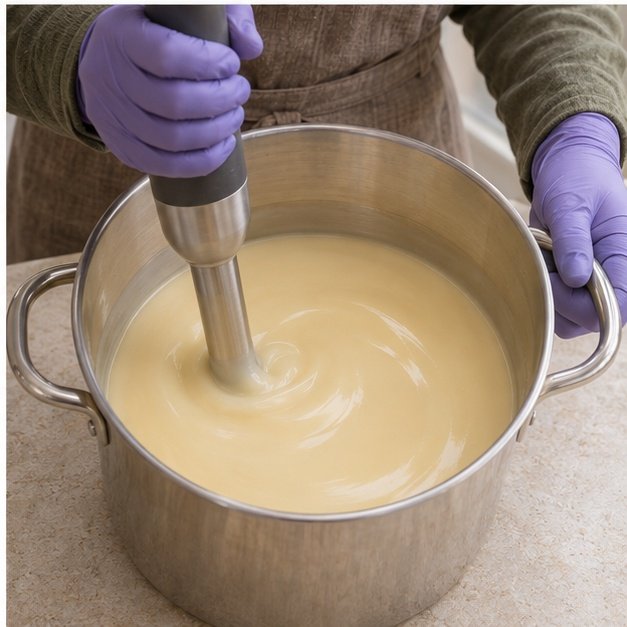
Recipe illustration: blend only until the mixture reaches a fluid light trace. - 05
Divide the batter approximately 25% coral, 25% mango-yellow, and 50% ivory. Stir each prepared mica dispersion into its matching portion by hand.
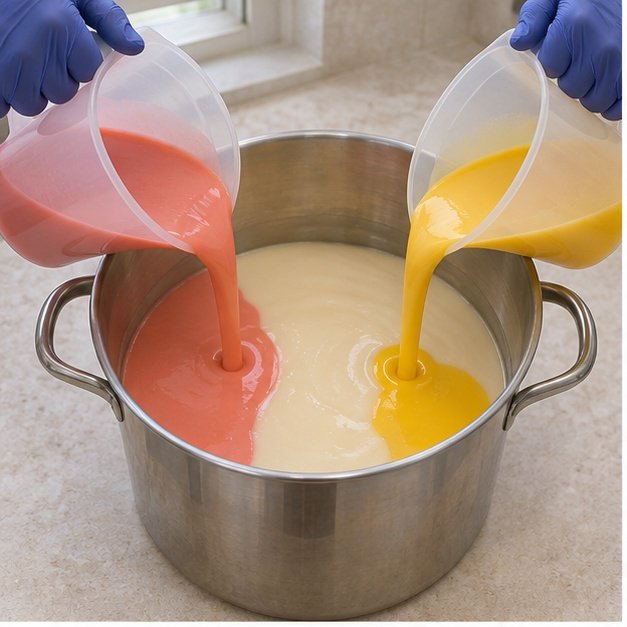
Recipe illustration: prepare two colored portions and keep the remaining batter ivory. - 06
Pour the two colored portions into opposite sides of the ivory batter, close to the surface to limit splashing. Draw a spatula through the pot once, slowly from one side to the other. Avoid repeated stirring so the colors stay distinct.
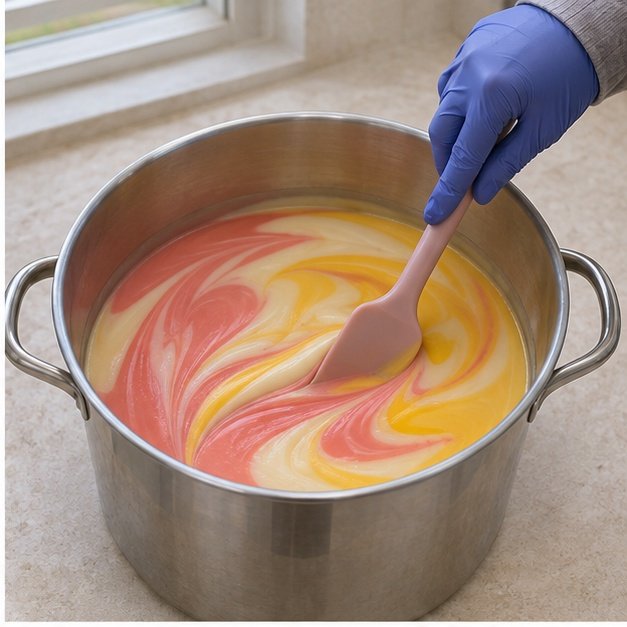
Recipe illustration: make one gentle sweep to connect the colors. - 07
Pour the batter in a continuous stream along the loaf mold. Tap the mold gently on a protected counter to release larger air pockets. Cover against dust and set it on a secure, heat-safe surface. Avoid forced heating or heavy insulation for this batch.
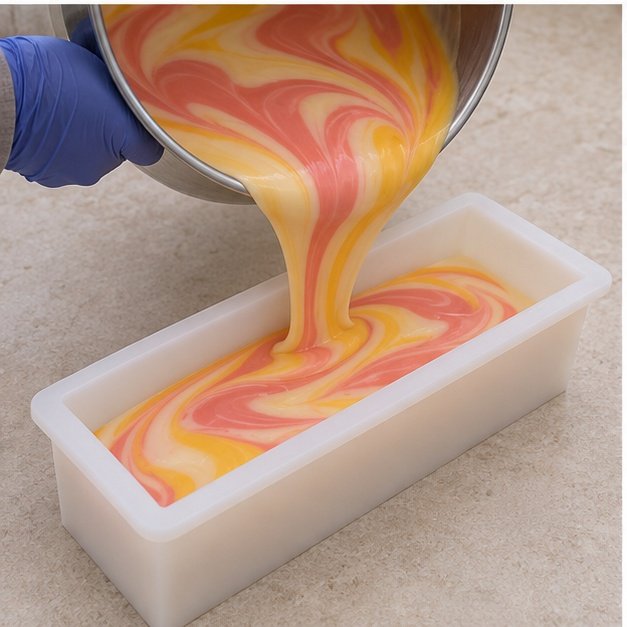
Recipe illustration: pour the marbled batter into the prepared mold. - 08
Check the loaf after 24–48 hours. If it dents or sticks, wait another day and check again. Wear gloves while handling young soap. Unmold when it releases cleanly and holds its shape, then cut into bars about 2.5 cm (1 inch) wide, keeping fingers clear of the blade.
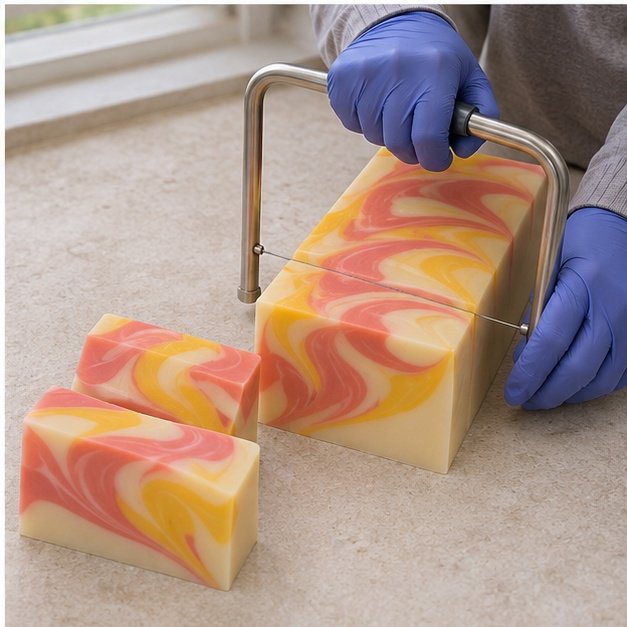
Recipe illustration: wait until the loaf holds its shape before cutting. - 09
Space the bars apart on a ventilated, nonreactive rack in a cool, dry place for 4–6 weeks. Turn them periodically and record the batch and cure dates. Curing does not correct an incorrectly weighed, lye-heavy, or separated batch; keep finished bars dry between uses.
05 /
Quick answers about the swirl
If the colors fade, check that the mica is rated for cold-process soap and stay within the supplier’s rate. No fragrance is used in this recipe; adding one is a recipe change, so check the exact product’s supplier and IFRA guidance for rinse-off soap.
Do not replace palm oil by equal weight without recalculating. An oil substitution changes the NaOH requirement and can also affect the batter and finished bar.