The batch at a glance
Cold-process soap formula
- Yield
- One 500 g oil batch; bar count depends on mold and cut size
- Total oils
- 500 g
- Superfat
- 5%
- Cure
- 4–6 weeks
- Fragrance
- Unscented
| Ingredient | Amount | Oil share |
|---|---|---|
| Olive oil | 225 g | 45% |
| Palm oil (regular palm) | 150 g | 30% |
| Coconut oil (76°) | 100 g | 20% |
| Castor oil | 25 g | 5% |
| Sodium hydroxide (NaOH)Calculated at 5% superfat; assumes 100% NaOH purity. | 69.52 g | — |
| Distilled waterSoapSpice’s disclosed cold-process baseline for this formula. | 160.63 g | — |
| Icy-blue cosmetic micaUse a colorant rated for cold-process soap; disperse in 5 g of the measured olive oil. | At the supplier’s rate | — |
| Navy cosmetic micaUse a colorant rated for cold-process soap; disperse in 5 g of the measured olive oil. | At the supplier’s rate | — |
| FragranceThis recipe is an unscented fresh base. | 0 g | — |
- Reserve 5 g of the measured 225 g olive oil for each mica dispersion, 10 g total. Do not add the reserved oil as extra oil.
- Divide the batter approximately 25% ivory, 25% pale blue, and 50% navy. Keep the ivory uncolored for contrast.
- The lye amount assumes 100% NaOH purity. Recalculate if you change the oils, weights, superfat, or liquid setting.
- The water amount is SoapSpice’s disclosed cold-process starting baseline, not an optimum inferred for every formula or process.
The listed 500 g oil blend matches the SoapSpice calculator at 5% superfat: 69.52 g NaOH and 160.63 g distilled water. The NaOH amount assumes 100% purity. Confirm supplier SAP values, oil types, NaOH purity, and measurements before making.
Recalculate this batch in SoapSpice01 /
A winter landscape in three soap colors
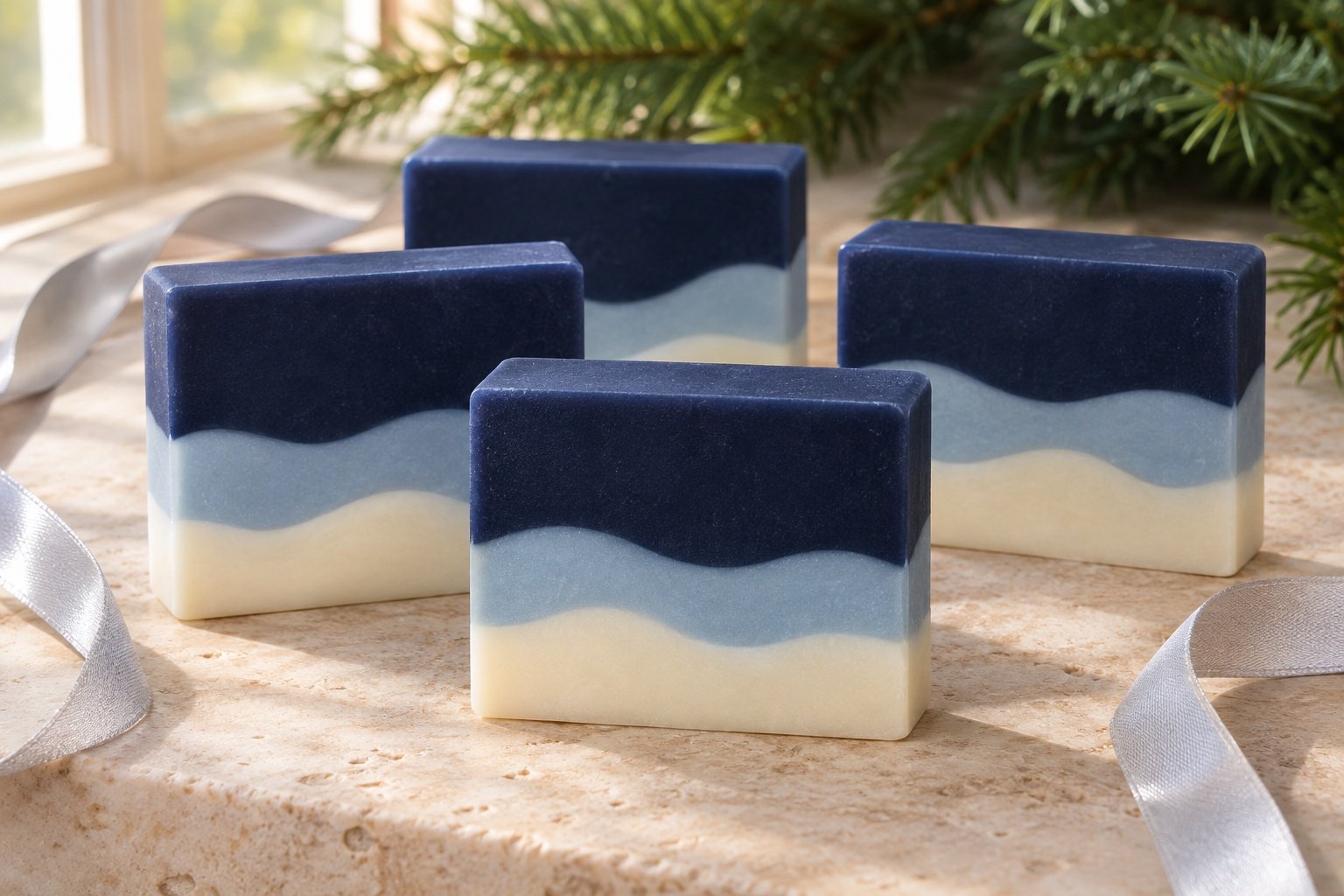
This unscented cold-process design turns a loaf into a quiet winter scene: a softly sculpted ivory snowbank, a pale-blue horizon, and a deep navy sky. The broad, shallow curves create the landscape without embeds, carving, glitter, or star decorations.
The key is to keep the lower layers shallow and smooth, then leave most of the loaf height for the navy. Gentle spooning helps the colors sit together without collapsing the snowbank.
- 500 g of base oils with a 5% superfat
- About 25% ivory, 25% icy blue, and 50% navy batter
- Two cold-process-stable cosmetic micas, each used at its supplier’s rate
- Allow about 60–90 minutes to make, 24–48 hours or longer before cutting, and 4–6 weeks to cure
- The named winter theme is visual only; the fresh soap is unscented
02 /
Formula and calculator check
For this exact oil blend, SoapSpice calculates 69.52 g sodium hydroxide (NaOH) at 5% superfat and 160.63 g distilled water. The NaOH amount assumes 100% purity. Confirm the oil types, supplier SAP information, NaOH purity, and all measurements before making.
In the cold-process calculator, select grams, enter the four oils and weights below, set superfat to 5%, choose distilled water, and leave fragrance at zero. Validate the formula again if you change any oil or setting.
| Ingredient or setting | Amount |
|---|---|
| Olive oil | 225 g (45%) |
| Regular palm oil | 150 g (30%) |
| Coconut oil (76°) | 100 g (20%) |
| Castor oil | 25 g (5%) |
| Total oils | 500 g |
| Superfat | 5% |
| Sodium hydroxide (NaOH) | 69.52 g |
| Distilled water | 160.63 g |
| Icy-blue cosmetic mica | Supplier rate; disperse in 5 g of measured olive oil |
| Navy cosmetic mica | Supplier rate; disperse in 5 g of measured olive oil |
| Fragrance | 0 g — unscented |
- Use regular palm oil, not palm kernel oil, and coconut oil listed as 76°.
- Melt and thoroughly mix palm oil before weighing so your portion has the intended fat blend.
- Micas are design additives, not base oils; keep them out of the lye calculation.
03 /
Equipment and NaOH safety
Prepare a reliable gram scale, thermometer, immersion blender, silicone spatulas, stainless-steel pot, lye-rated heat-resistant polypropylene pitcher, batter cups, and a silicone loaf mold that holds at least 800 g of batter. Set out separate labeled cups for the ivory, blue, and navy portions.
Wear splash goggles, chemical-resistant gloves, and long sleeves. Work with ventilation, keep children and pets away, and use dedicated soapmaking equipment. Avoid aluminum and fragile glass for raw soap or the lye setup.
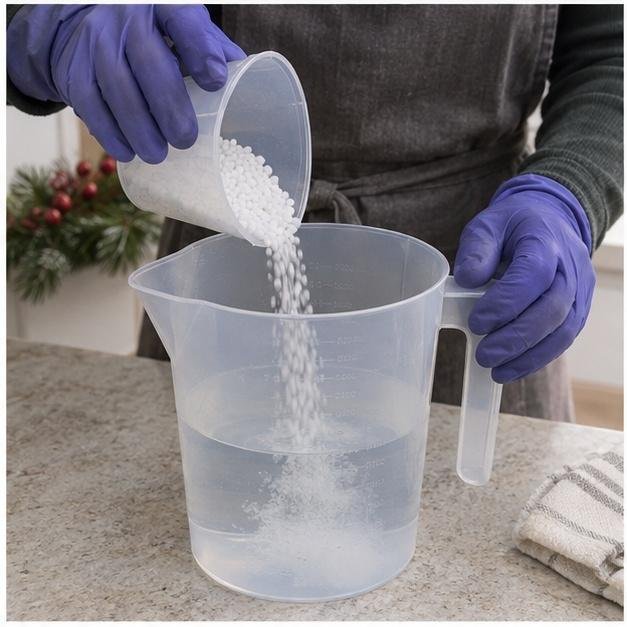
Read the NaOH supplier’s safety sheet first. Slowly add sodium hydroxide to measured distilled water while stirring—never pour water onto dry NaOH. Avoid breathing the hot vapor and leave the solution to cool securely. For exposure, rinse with running water and follow the supplier’s emergency guidance; do not use vinegar.
04 /
Build the snowbank soap step by step
Prepare the two mica dispersions and label the pitchers before handling the lye. Keep all colors fluid enough to pour, and let only the smaller ivory portion reach a soft medium trace so it can hold a shallow ridge.
- 01
Prepare the winter palette. Disperse the navy and icy-blue micas separately in 5 g portions of olive oil reserved from the measured 225 g. Label both cups. Keep the ivory portion uncolored for a clear contrast with the winter sky.
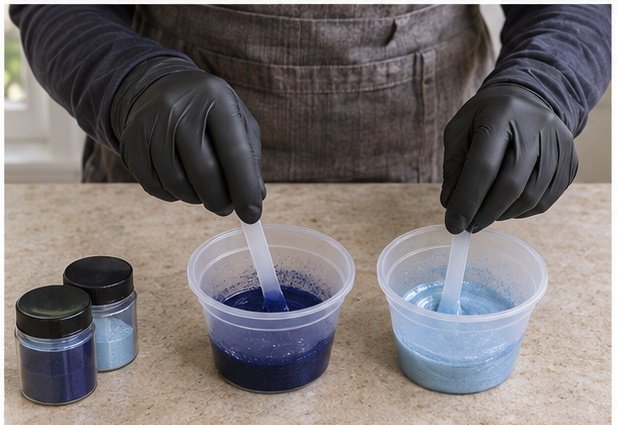
Illustration: disperse each mica separately and label its cup before mixing the batch. - 02
Melt all hard fats fully. Thoroughly melt and mix the palm oil before weighing its 150 g portion. Melt the coconut oil and combine it with the palm, olive, and castor oils, keeping the reserved 10 g olive oil aside. Cloudy or partly solid fats can make batter thickness misleading.
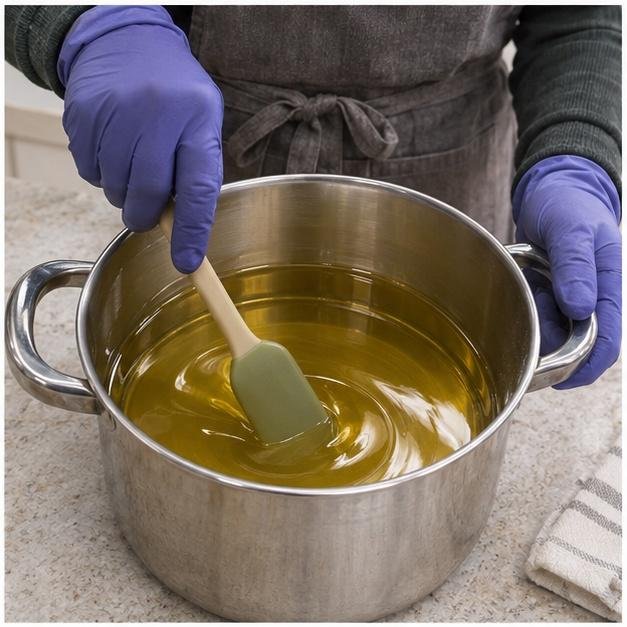
Illustration: thoroughly combine the measured oils before making the soap batter. 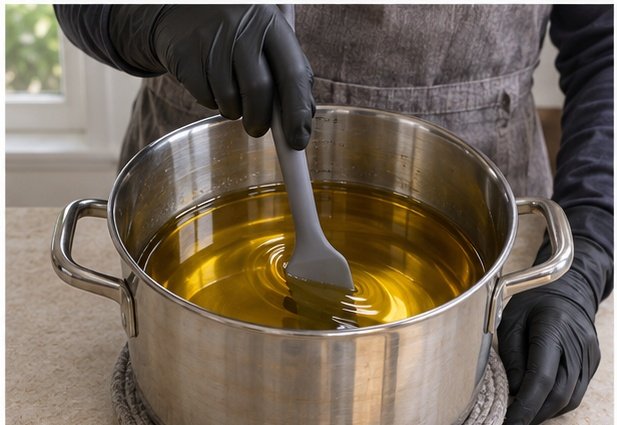
Illustration: keep the hard fats fully liquid and well mixed. - 03
Prepare and cool the lye solution. Weigh 160.63 g distilled water and 69.52 g NaOH separately. Slowly add NaOH to the water while stirring, never the reverse. Let the solution cool securely with ventilation. Aim for the oils and lye solution to be around 38–43°C (100–110°F), with all hard fats fully liquid.
- 04
Blend, divide, and color. Slowly add the lye solution to the oils. Use brief submerged blender pulses until emulsified. Divide the batter approximately 25% ivory, 25% pale blue, and 50% navy; stir the mica dispersions into the blue and navy portions. Keep blue and navy fluid, while letting the smaller ivory portion reach soft medium trace. Blend only the portion that needs more structure.
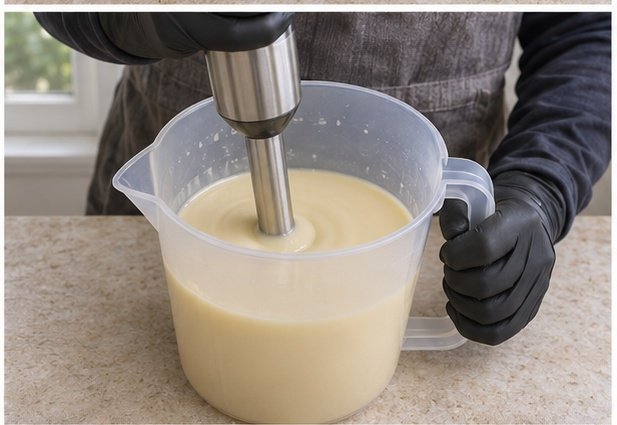
Illustration: blend to emulsion, then divide and color the batter portions. - 05
Sculpt the snowbank. Spoon the ivory batter into the mold. Use the back of a spoon to make one broad, shallow ridge along the loaf. Avoid sharp peaks and deep troughs that can trap air. The surface should support a gentle spoonful of pale-blue batter without collapsing.
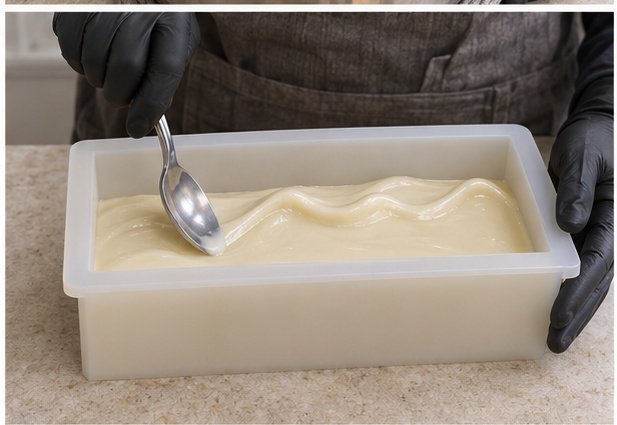
Illustration: shape a soft ivory ridge without sharp peaks or deep troughs. - 06
Add the pale-blue horizon, then the navy sky. Spoon the pale-blue batter close to the ivory surface and form a second shallow curve. Add the navy over a spatula to soften the pour and fill the remaining mold space. Keep the top flat; do not add navy before the pale-blue horizon is complete.
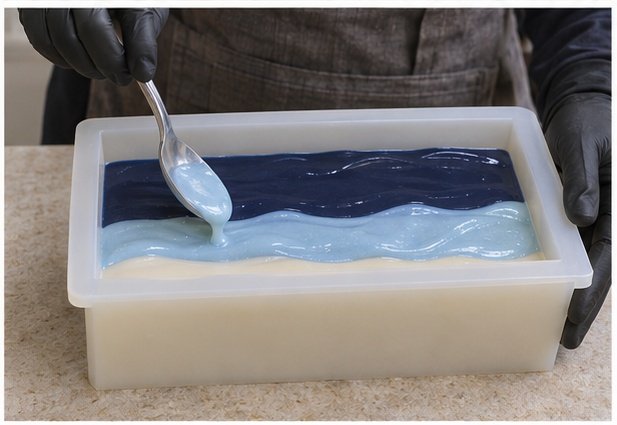
Illustration: the finished three-color landscape; place pale blue between ivory and navy. - 07
Unmold and cut crosswise. Leave the loaf protected from dust and check it after 24–48 hours or longer. When it is firm and releases cleanly, wear gloves to unmold and cut crosswise into bars about 2.5 cm (1 inch) thick. Cutting along the length can miss the intended landscape face. Small differences in each snowbank are expected.
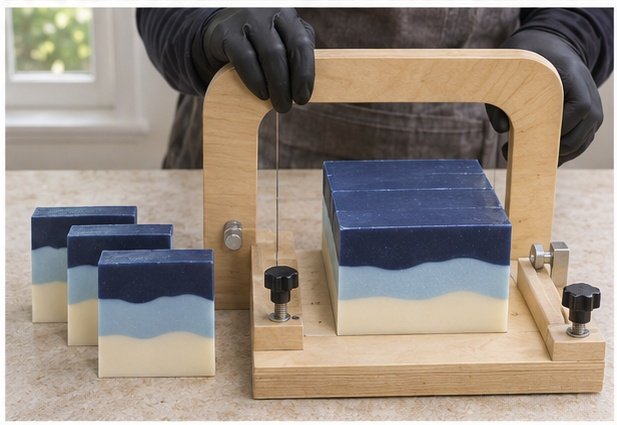
Illustration: cut across the loaf to reveal the landscape on each bar.
05 /
Cure, troubleshoot, and plan gifts
Space the bars on a nonreactive rack in a dry, ventilated area for 4–6 weeks, turning periodically. Record the batch date, exact ingredients, and observations. Curing can improve firmness, but it cannot correct a lye-weighing error or separated batch. Wrap only dry, cured bars in breathable paper and include an accurate ingredient list.
Plan backward from the intended gift date and allow at least six weeks plus time to assess the bars. Cure time is a guideline, not a promise that a batch is ready on a particular date; do not rush the cure.
| What you notice | What to check next time |
|---|---|
| Snowbanks disappear | The ivory layer may be too thin or overworked. Build a shallow ridge only after it can hold a soft shape. |
| Holes appear under the blue | The ridges may be too sharp or the batter too thick. Spoon into low spots and gently settle the mold. |
| Navy lather is strongly tinted | The colorant dose may be too high. Reduce it within the supplier’s guidance; dark color alone is not a reason to add more. |