01 /
First, identify what you see
A batter that suddenly gets thick can have several causes. The next step depends on whether the mixture is smooth and uniformly emulsified, or whether it shows signs of a different mixing problem.
This guide’s simple-molding approach is only for a correctly weighed, known formula that was already emulsified and is now smooth and thick. It is not a way to repair uncertain measurements, separation, or a batch that has not formed a stable emulsion.
| What you see | Possible explanation | What to do next |
|---|---|---|
| Smooth, uniform batter thickens after blending or scent | Acceleration or advanced trace | If the emulsion is stable and there is no separation, use the simpler spoon-and-mold approach below. |
| Waxy or grainy thickness before a stable emulsion; hard fats are cool | Possible false trace | Do not assume it is ready to mold. Check temperatures and get experienced, recipe-specific guidance. |
| Rice-like lumps, especially after fragrance | Possible ricing | Do not use the smooth-batter rescue blindly; seek guidance for the formula and fragrance. |
| Oil layer, watery pockets, or liquid leaking from the mixture | Separation or incomplete emulsion | Stop this rescue sequence. Keep the batch protected and contained; do not use or gift it while the cause is uncertain. |
| Sudden solid mass that cannot be stirred | Seizing | Do not force the blender. A separate, controlled rebatch assessment may be needed. |
02 /
Keep protective gear on
Raw soap remains caustic even when it is thick. Keep splash goggles, chemical-resistant gloves, and sleeves on. Protect the work surface, keep children and pets away, and do not touch, taste, or “zap test” a questionable batch.
If the mixture becomes unusually hot, expands, or leaks, do not move or handle it unnecessarily. Keep people clear of the area and follow the suppliers’ safety instructions.
03 /
What counts as a rescue candidate?
A possible candidate has known ingredients and correctly measured weights, reached a stable emulsion, and is now smooth and uniform with no oil or watery pockets. If any ingredient, weight, or step is uncertain, set the batch aside for assessment instead of adding anything to it.
Texture alone cannot show whether a recipe is safe. A simpler appearance may be acceptable for a sound batch; uncertain formula or visible separation is a different concern.
04 /
False trace is not acceleration
Cooling hard fats can make batter look thick before the oils and lye solution are properly emulsified. That is not the same situation as a fully mixed batter thickening after fragrance or blending.
Spoon-molding an incompletely mixed batch can trap separate phases. If you are unsure whether the batter is uniformly emulsified, stop and get experienced guidance rather than treating thickness as proof that it is ready.
05 /
Rescue only smooth, thick batter
If the formula and emulsion are known and the batter is smooth with no separation, simplify the design and move carefully.
- 01
Turn off and unplug the immersion blender. Set it securely on a protected tray. More powered mixing may thicken an already-smooth batter further. Keep the mold close and leave intricate swirls for another batch.
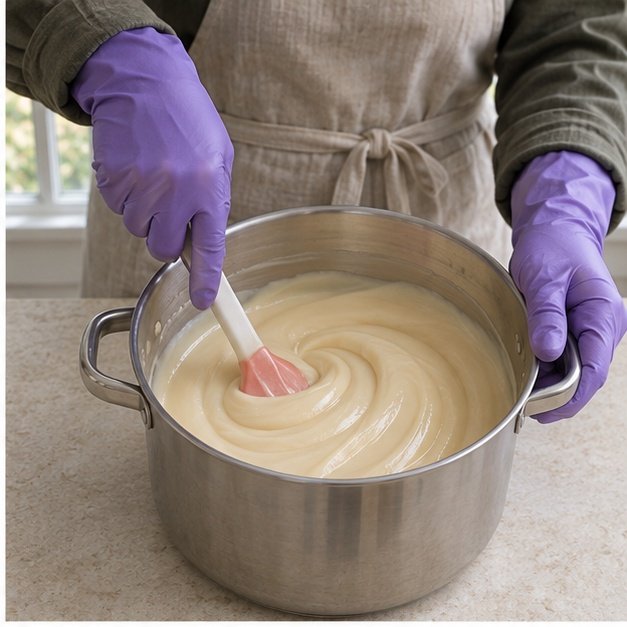
Guide illustration: stop powered blending and avoid extra mixing. - 02
Stir gently by hand with a spatula, scraping the sides and base without whipping in air. If the batter remains smooth but holds soft peaks, move promptly to molding. If oil or watery liquid separates, stop this sequence and set the batch aside for assessment.
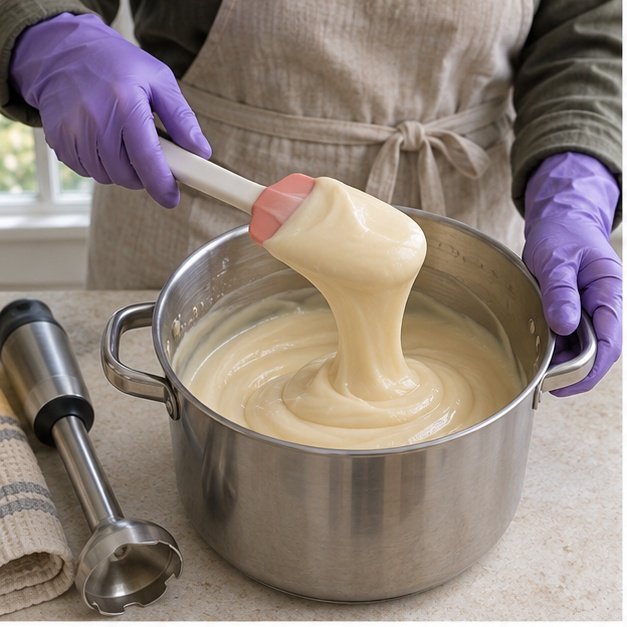
Guide illustration: assess whether the batter is smooth and uniform. - 03
Spoon the batter into the mold. If colors are already divided, alternate large spoonfuls; press gently into the corners to reduce gaps. If it is still one color, keep the design simple. Do not add color now if doing so would delay molding.
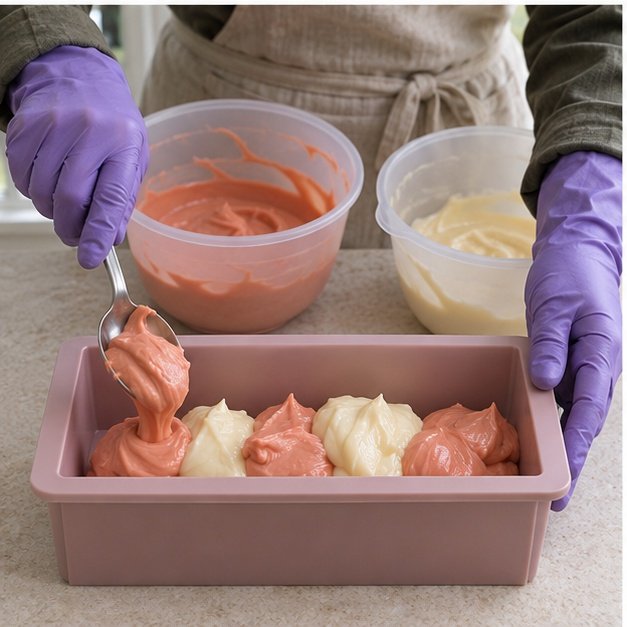
Guide illustration: spoon thick, already-emulsified batter into the mold.
06 /
Finish simply and assess later
Once the batter is in the mold, keep the area protected and wait for the loaf to firm before cutting.
- 01
Tap the mold gently on a protected surface and smooth the top with the back of a spoon. Avoid forceful banging that could splash raw soap. Do not add unmeasured water, oil, alcohol, or extra lye to force the original design back.
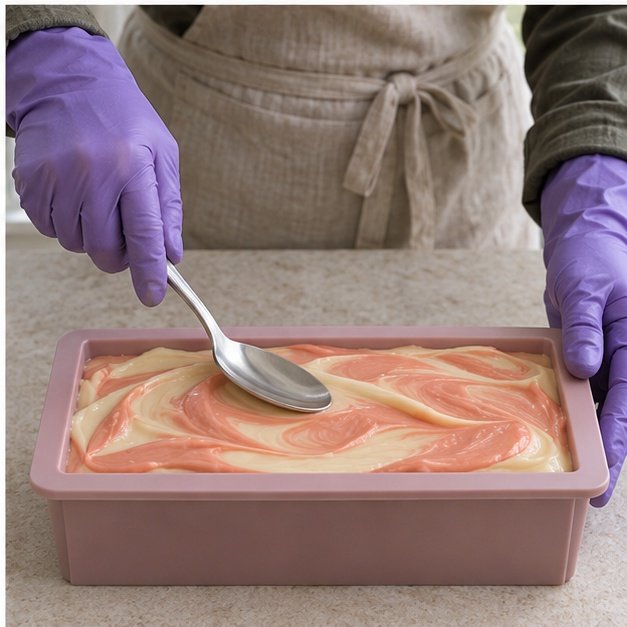
Guide illustration: settle the batter gently and smooth the top. - 02
Check the loaf after 24–48 hours and wait longer if it dents or sticks. Wear gloves to unmold and cut. A rustic pattern or small cosmetic air gaps may occur. Visible liquid pockets, oily weeping, or unusual crumbly areas need assessment before the soap is used; appearance alone does not identify the cause.
- 03
If the formula was correctly measured and the batter properly emulsified, cure the bars with airflow for 4–6 weeks. Record the ingredients, exact weights, temperatures, when thickening began, and any fragrance addition. Curing does not neutralize excess lye from a weighing error; do not use, sell, or gift a questionable batch while its cause remains unresolved.
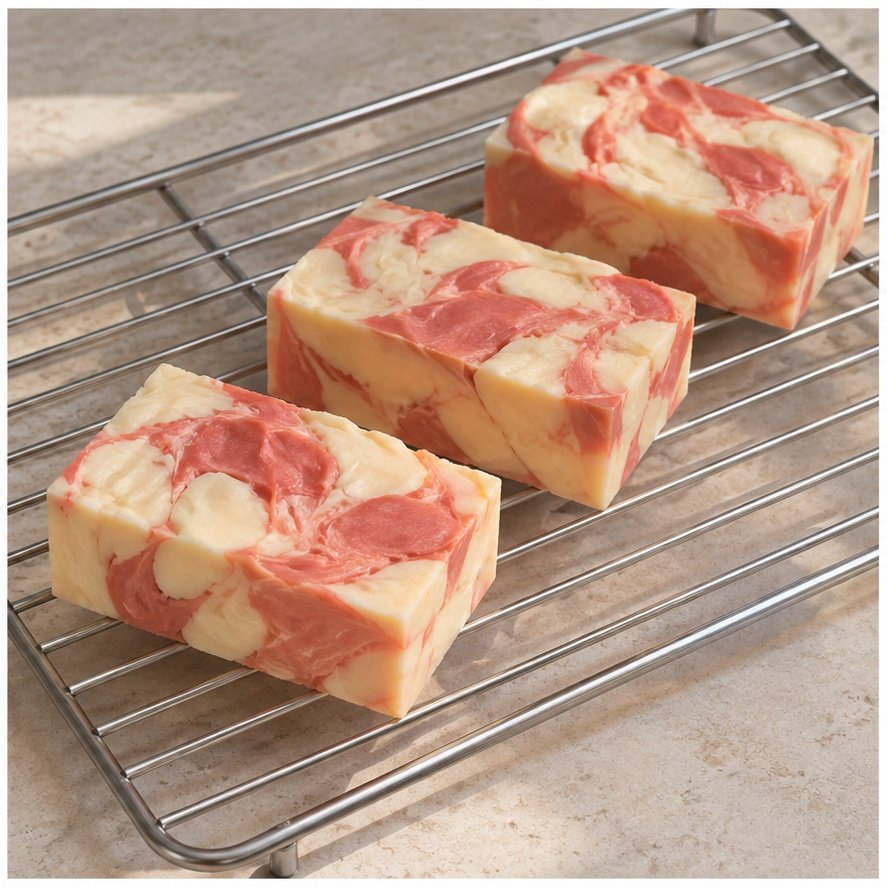
Guide illustration: leave air space around bars during a 4–6 week cure.
07 /
When is rebatching appropriate?
Rebatching is a separate procedure that may suit some known, correctly formulated batches. It is not a universal correction for uncertain measurements, separated ingredients, or an unknown cause. Get a recipe-specific assessment before attempting heat-based recovery.
Do not put a misbehaving or unusually hot batch into an oven as a general rescue. Added heat can make handling problems worse.
08 /
Prevent the next rushed pour
A prepared workspace and a simple design leave more attention for observing how the batter behaves.
- Prepare the mold, color dispersions, cups, and spatulas before combining the lye solution and oils. Choose a single-color or spoon-plop design for a diagnostic batch.
- Enter the actual oil identities and weights in the SoapSpice calculator. Confirm NaOH versus KOH, superfat, lye purity, and the liquid setting; record the water concentration or lye-to-water ratio.
- Keep hard fats fully liquid and check both temperatures. For the companion palm-and-coconut blend, 38–43°C (100–110°F) is a practical starting range; other formulas need their own temperature plan.
- Blend in short pulses, alternating with hand stirring. Inspect the mixture instead of blending for a fixed time, and switch to a spatula once it reaches the emulsion and trace needed for the design.
- Read the fragrance supplier’s cold-process notes and permitted use rate. Test fragrance behavior separately before using an elaborate design, and change one variable at a time.
- Keep a batch log with oil brands and lots, lye purity, formula, water concentration, temperatures, additives, blending pattern, and when thickening began.
09 /
Questions makers ask
Can thick batter be made thin again? There is no dependable universal reversal. Smooth accelerated batter may simply need a simpler molding method; false trace, ricing, and separation need different responses.
Does rapid thickening mean the soap is ruined? Not necessarily. A correctly formulated, fully emulsified batch may still become usable bars even if the design changes. Uncertain ingredients, wrong weights, and separation are different concerns and need assessment.
Should the mold go straight into the oven? Not as a general rescue. This guide uses room-temperature molding only for the smooth, already-emulsified batter scenario.